Our Publications
Explore our collections of published and unpublished articles. View published works online or download summaries and full documents for our pre-prints.
Peer Reviewed Journal Articles

Oulo, B., Thomas, M. and Sidle, A. A. (forthcoming) 'Measuring Agentic Capacity: A Cross-Cultural Validation of the Adolescent Girls Agency Scale.' Journal of Social Science and the Humanities.Forthcoming
Abstract/description not available. Check back soon for details.

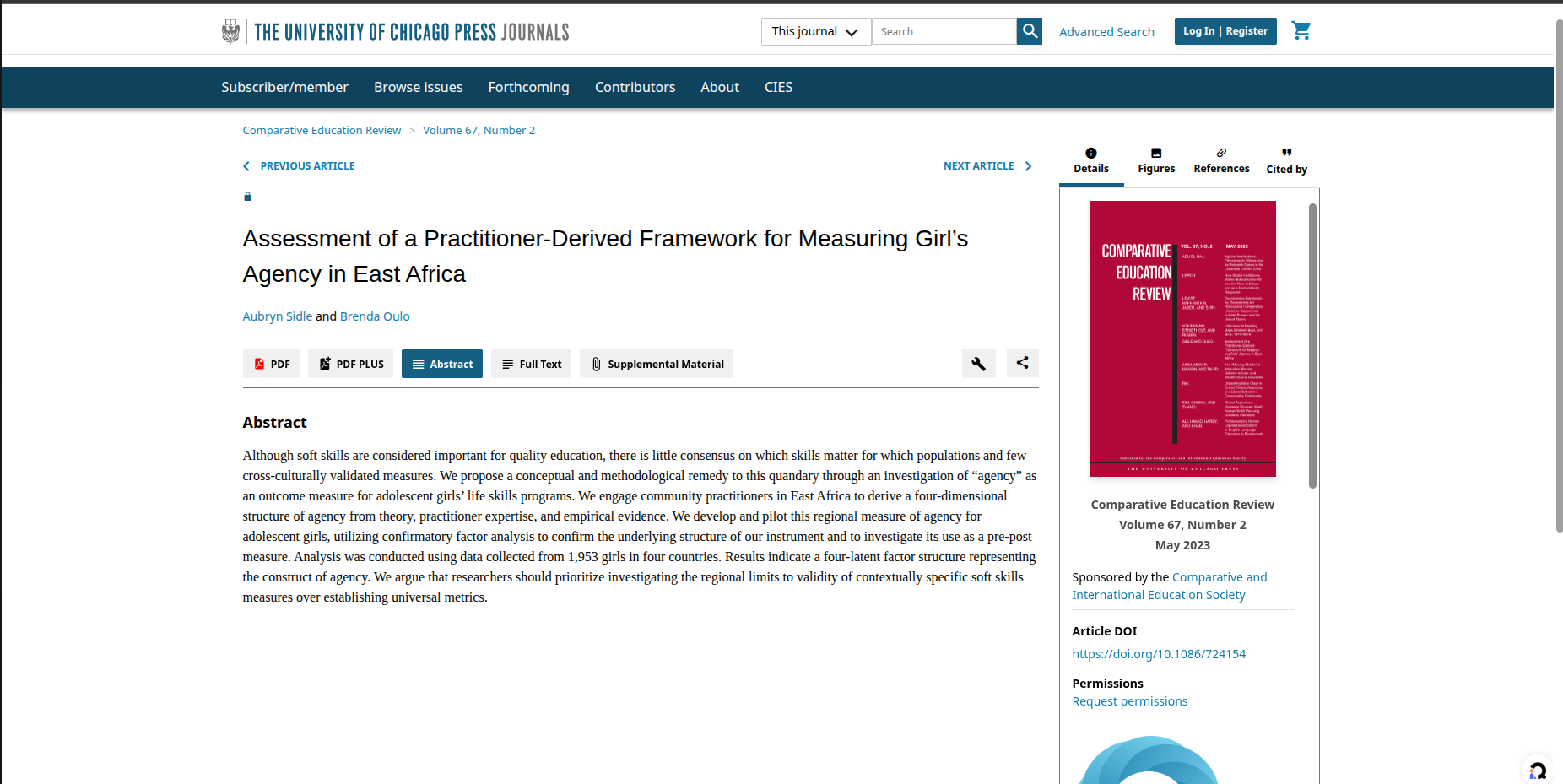
Sidle, A., & Oulo, B. (2023). Assessment of a practitioner-derived framework for measuring girl's agency in East Africa. Comparative Education Review, 67(2), 331-352.
Although soft skills are considered important for quality education, there is little consensus on which skills matter for which populations and few cross-culturally validated measures. We propose a conceptual and methodological remedy to this quandary through an investigation of “agency” as an outcome measure for adolescent girls’ life skills programs. We engage community practitioners in East Africa to derive a four-dimensional structure of agency from theory, practitioner expertise, and empirical evidence. We develop and pilot this regional measure of agency for adolescent girls, utilizing confirmatory factor analysis to confirm the underlying structure of our instrument and to investigate its use as a pre-post measure. Analysis was conducted using data collected from 1,953 girls in four countries. Results indicate a four-latent factor structure representing the construct of agency. We argue that researchers should prioritize investigating the regional limits to validity of contextually specific soft skills measures over establishing universal metrics.
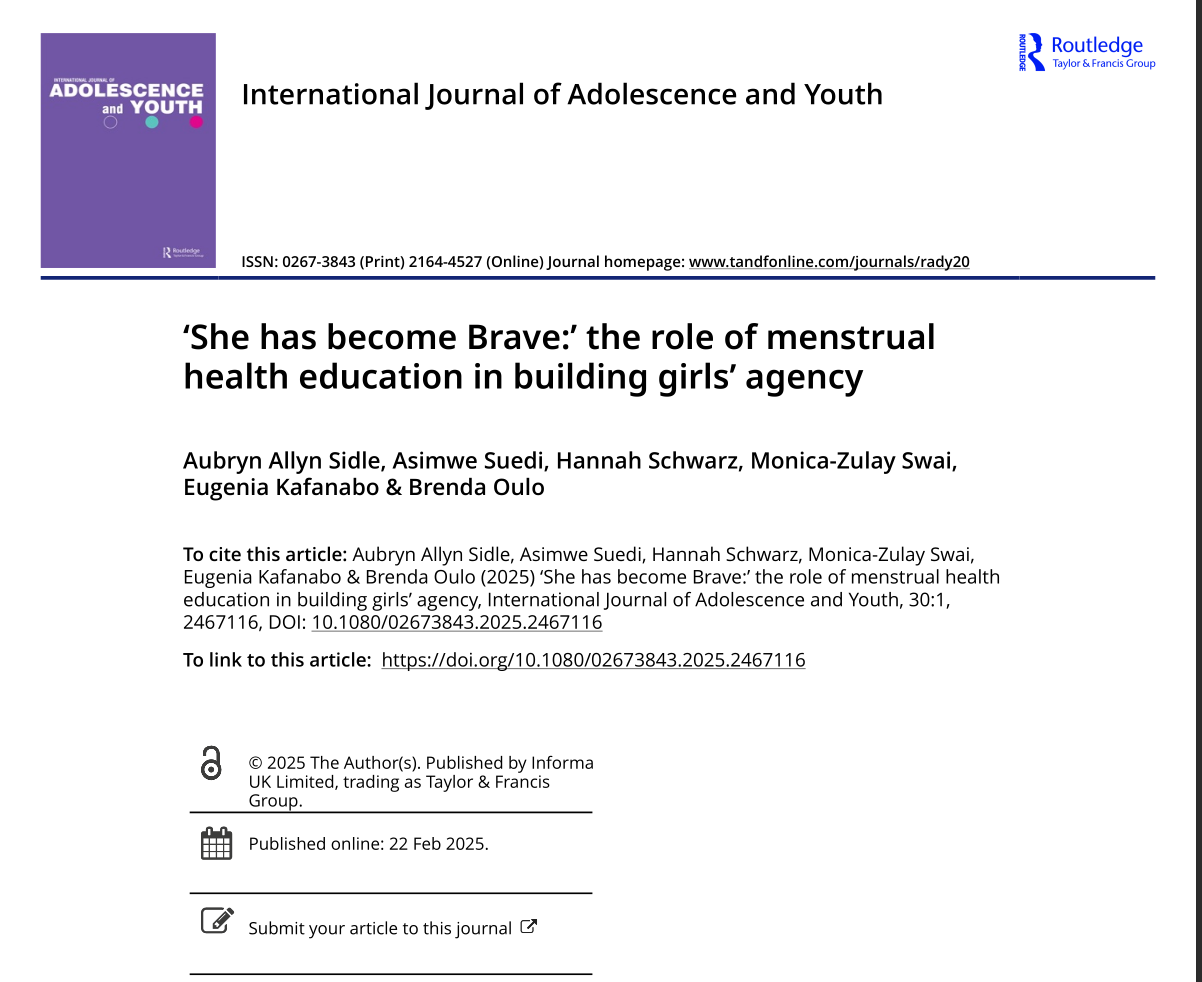
Sidle, A. A., Suedi, A., Schwarz, H., Swai, M. Z., Kafanabo, E., & Oulo, B. (2025). 'She has become Brave:' the role of menstrual health education in building girls' agency. International Journal of Adolescence and Youth, 30(1), 2467116.
This paper investigates the causal pathway of life skills Binti Shupavu program in Tanzania to show how and why the program works to support the development of adolescent girls’ agency. We collected data from 52 stakeholders via 15 focus group discussions and interviews and utilized a qualitative process tracing methodology to construct a causal pathway from the Binti Shupavu Health and Wellness curriculum, towards girls’ agentic capacity. The findings reveal that successfully navigating the ‘shock’ and stress of menstruation at school, and the practice of self- care, leads to improved self-confidence (kujitambua), ‘bravery’ (self- advocacy) and decision-making around bodily autonomy. This process is facilitated by destigmatizing menstruation and catalysing social norms change within communities through parental engagement sessions and girl-centred pedagogy. We argue that the application of menstrual health knowledge provides important ‘cognitive bridging’ opportunities for the development and transfer of key soft skill competencies to girls’ lives.
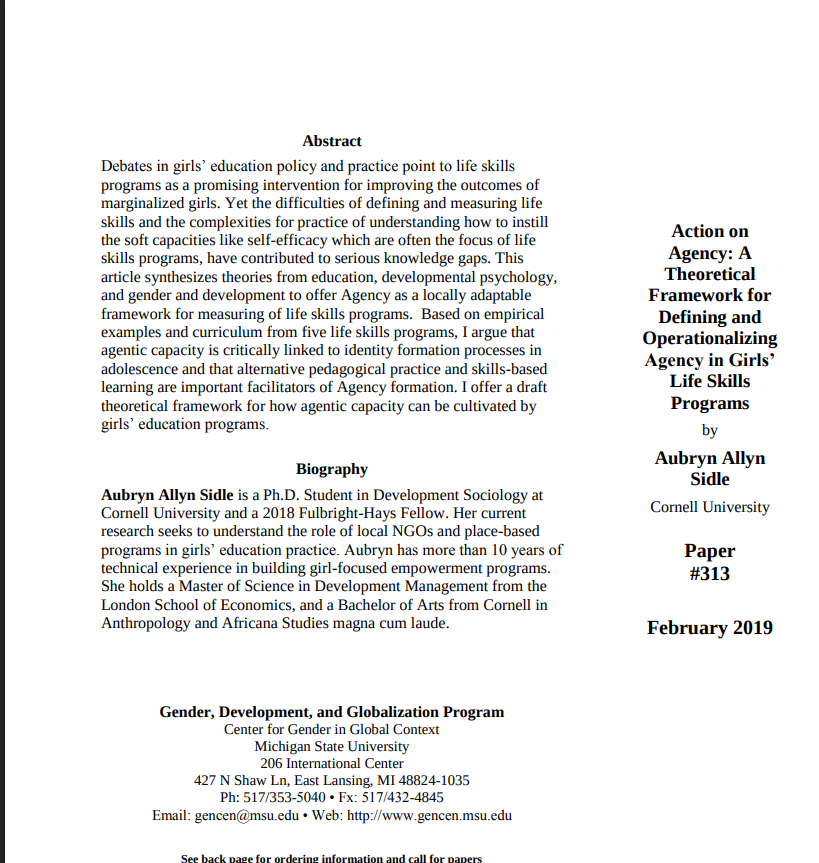
Sidle, A. A. (2019). Action on agency: A theoretical framework for defining and operationalizing agency in girls' life skills programs. Gendered Perspectives on International Development: Working Papers, (313), 0_1-21.
Debates in girls’ education policy and practice point to life skills programs as a promising intervention for improving the outcomes of marginalized girls. Yet the difficulties of defining and measuring life skills and the complexities for practice of understanding how to instill the soft capacities like self-efficacy which are often the focus of life skills programs, have contributed to serious knowledge gaps. This article synthesizes theories from education, developmental psychology, and gender and development to offer Agency as a locally adaptable framework for measuring of life skills programs. Based on empirical examples and curriculum from five life skills programs, I argue that agentic capacity is critically linked to identity formation processes in adolescence and that alternative pedagogical practice and skills-based learning are important facilitators of Agency formation. I offer a draft theoretical framework for how agentic capacity can be cultivated by girls’ education programs.